In some past reviews, as well as on the Dinosaur Toy Forum, I have confessed that I find carcharodontosaurids somewhat dull, at least when compared to other large theropods, such as tyrannosaurids, spinosaurids, or abelisaurids. Carcharodontosaurids are mostly basic in form and virtually identical to each other, to my eye. As I learn more about them though, I’m coming to appreciate them more, and there are some that I even count among my favorite large theropods, such as Acrocanthosaurus.

I was first introduced to “Acro” when I read Robert Bakker’s novel, Raptor Red, back around 1997. I immediately became fascinated by this ridge-backed, early Cretaceous allosauroid that approached Tyrannosaurus rex in size. As such, Acrocanthosaurus is one of the best represented dinosaurs in my collection, with my shelves displaying figures by Carnegie, Battat, Safari Ltd., CollectA, and Kaiyodo. And I’ve reviewed several of them too. Still, as figures improve in quality and science marches forward, there’s always room for a new and improved model of a favored genus on the shelf and since I didn’t much like PNSO’s Acrocanthosaurus I was thrilled when Haolonggood announced there’s.
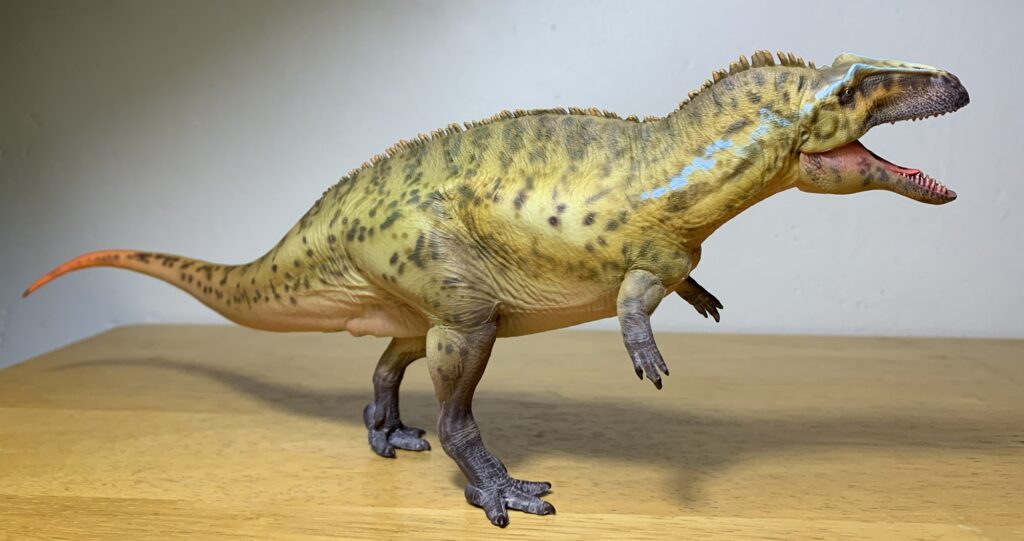
The Haolonggood Acrocanthosaurus is presented in a rather dynamic pose, by Haolonggood standards. It is striding forward and angled upwards, with the head pointing slightly upwards and tilting towards the right and the tail sinuously weaving about. This pose makes the figure pair well with Haolonggood’s rearing Sauroposeidon, a model I am unlikely to own that represents a sauropod that lived alongside Acrocanthosaurus.

The figure measures 11.8” (29.9 cm) and stands about 4” (10.16 cm) at the top of the head. Acrocanthosaurus is estimated to have measured 36-38’ (11-11.5 meters) which puts the figure at about 1/36-1/38 in scale, which I consider close enough to the advertised and often desired 1/35 scale. The head alone measures 1.5” (3.81 cm) while that of the actual animal measures 4.0–4.2’ (1.23–1.29 meters). Using skull length gives us a scale of 1/32-1/33.6, so the head is proportionally a bit too small. That’s kind of ironic since I thought the head of PNSO’s looked too large!

Proportions aside, the head appears sufficiently accurate to the actual Acrocanthosaurus. It is long, low, and narrow, with a prominently large antorbital fenestra that’s outline is slightly visible under the skin. The outline of the orbit and temporal fenestra are also slightly visible. The lower jaw has a thin dentary and dramatically deepens towards the rear. A pair of low, keratinous crests run along the snout and over the eyes. The fine details are up to Haolonggood’s usual standards, with complex detailing over the head and on the inside of the mouth and of course, there is the notable addition of lips. The jaw is articulated and when closed the lips seal decently enough but not tight together.

The neck is deep and muscular with a lot of skin creases. The arms are modestly sized but muscular, with thick rolls of skin around the shoulder joints. The innermost claws should be larger and more deeply hooked but the claws are otherwise finely sculpted and sharp.


The scales over the body are finely sculpted to such a degree that the figure feels smooth in places. Tarsal scutes are sculpted over the thickly padded toes. Heavy creases and folds of skin can be seen along the lower torso, around the limb joints, and at the base of the tail. A deep groove within the musculature can be seen running down the length of the tail.

The ridge along the back is thick and muscular, which I greatly prefer over the more sail-like ridge I’ve seen on some other reconstructions. A row of iguana-like spikes runs from the nape to the hips, and these vary in length, with some clustered close together and gaps between others, making them appear natural. Fine creases of stretched skin run along where the ridged back joins the body. Large, oval shaped feature scales are also sculpted along the ridge. All bodily orifices are present.


As usual, the Haolonggood Acrocanthosaurus comes in two colors. Dong Ping is brown and yellow while Zhang Qing is green. I went with the green Acro since I’ve always liked green dinosaurs but actually own only a few green dinosaurs by Haolonggood. The figure is olive green with yellow green flanks and a pale green and pink underside. Broken, dark green stripes run along the back, and dark green speckles of various sizes run along the sides.

A dark gray wash over the snout brings out the fine details there, and bright orange patches are painted over the antorbital fenestra. The crests are painted electric blue, and the blue radiates like lighting from the crests, down along the neck, and stops over the shoulders. The spines along the back are green at their base with orange tips and the tail is tipped in bright orange. The hands and feet are dark gray with black claws. The eyes are yellow with black pupils. The inside of the mouth is pink, red, and glossy, and the teeth are white with a red and pink wash that makes them appear bloodied.


The paintjob is interesting and complex without looking garish or unnatural. I enjoy how the various shades of green blend together, the pattern of dark speckles, and the slight touches of orange and blue. The brown and yellow version has the same patterning as this one, just different colors. It lacks the orange and blue accents so would make a good female counterpart if one wanted the green figure to be a more flamboyant male. There are a few paint mistakes on my copy but they’re very minor. Some of the pink and red used on the inside of the mouth can be seen on the jaw. The figure is otherwise beautiful and I love it.

The Haolonggood Acrocanthosaurus is now the definitive Acro in my collection and despite Acro being well represented in my collection this is the first Acro to nail the look of the genus to my satisfaction. Aside from the head appearing a tad too small, I have no complaints and highly recommend this figure.

Trending Products