by Ted Mininni, President & Creative Director, Design Force Inc.
Although only the savviest of toy industry professionals may realize this, blind boxes and bags have been around for decades. And, surprisingly, they didn’t begin as a novelty trend. They evolved from randomized vending and trading formats into what we would refer to today as a legitimate packaging strategy. One that supports collectability and retail growth.

Starting in the 1960s, capsule toys were dispensed from vending machines. Consumers didn’t know what they were getting when they inserted their coins and turned the crank. In that scenario, the packaging was the capsule. It was essentially a distribution solution rather than an “experience.” These vending machine toys led to trading cards, which awakened the collector in me as a kid. I spent quite a bit of my allowance “chasing” my favorite players’ cards while enjoying the anticipation as I opened countless packs, hoping I’d get what I “needed.”

It wasn’t until the early to mid-2000s that blind bag packaging emerged. They contained small figurines, licensed character minis, and impulse toys. At this point, blind packaging was a tactical, not strategic, move.
The blind box and bag trend, as we know it today, became fully realized around 2010. That’s when it became intentional, systematized, and central to the product’s design. It’s when packaging, product, and collectability merged into a single experience. Fast-forward to today, and we, as package designers, have become the architects of that mystery experience.
From my perspective, we can no longer accurately describe blind packaging as a trend. I truly believe it’s here to stay as an industry staple. But why does it persist? Why are consumers still drawn to blind boxes and bags? The appeal is tied directly to consumer psychology and shopping behavior. It’s driven by anticipation, ritual, and collectibility. Blind boxes and bags turn a low-cost purchase into a memorable experience. The ritual of unboxing fuels consumers’ desire to repeat the experience, which leads to repeat purchases. And, because they love it so much, they share the unboxing experience on their favorite social media platforms. Yet the real trick isn’t just that blind packaging delivers an unboxing experience. It’s in how that experience is delivered.
Blind packaged toys continue to resonate with consumers because they’re created with intent. These packaging formats work well because package designers have transformed them from simple ways to hide the products they contain into thoughtfully conceived systems. Today, the most sought-after blind-packaged toy brands aren’t achieving success from mystery alone. Their success comes from how clearly their packaging communicates the promise, how it delivers the reveal, and how effectively it encourages collecting behavior.
Through my lens as a package designer, I can identify three specific design approaches that stand out in the brands that are thriving in this category.

SERIES ARCHITECTURE AND VISUAL SYSTEM CLARITY
Today’s blind packaging doesn’t sell one-off items. It sells an entire series of products. Consumers now expect that they’re buying into the concept of collecting. For this to be successful at retail, the fact that each product is part of a broader assortment must be communicated clearly on-pack.
The LEGO Group’s Collectible Minifigures line is a textbook example of this approach. It’s successful because it doesn’t try to sell “a figure.” It sells the idea of a complete series. The packaging functions like a tiny billboard, communicating at a glance that this product is part of a set, that the set is finite, and that you’re embarking on a collecting journey. A consistent communication hierarchy, distinctive series branding, and color do the heavy lifting. What’s most powerful about this packaging is what consumers understand without seeing what’s inside. From a design perspective, the best blind packaging hides the product, not the value proposition.
DISCOVERY BY DESIGN
This approach to blind packaging organizes the experience with the individual product components once the outer package is opened. The packaging structures the journey from reveal to final product, guiding the consumer through the individually wrapped components as they assemble it. Therefore, the component discovery and the product build are part of a designed, sequential experience.
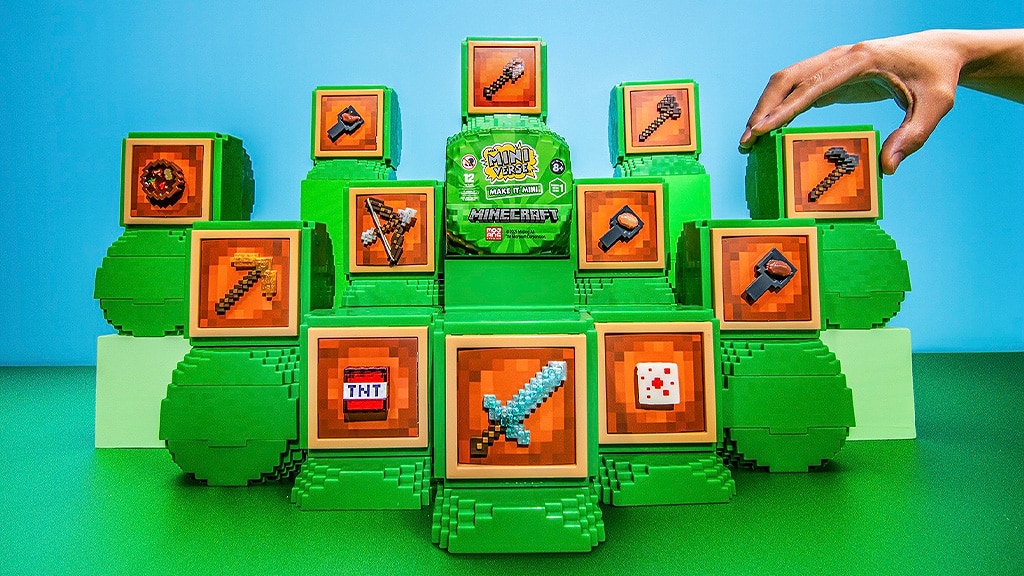
MGA’s Miniverse capsules work exactly in this way. The packaging is truly blind, but once opened, an insert card explains the individual components and how to assemble them. The consumer unwraps each piece and builds the product in a single, cohesive “play” experience. Opening the package isn’t the end. It’s the beginning of the experience for which the packaging has been intentionally organized.
CONTROLLED, MULTI-STEP REVEAL
This last approach to blind packaging literally paces consumers’ anticipation. The packaging itself determines the order in which components are revealed to consumers through physical barriers such as doors, tear-away panels, and individual compartments. Instead of seeing everything at once, the packaging establishes a narrative and controls the sequence of discovery.
Although many examples are a bit older, the controlled, multi-step reveal remains a viable and influential approach to blind packaging. Just Play’s Hairdorables dolls leveraged multi-panel boxes with doors and compartments that revealed accessories before the doll itself, while MGA built the L.O.L Surprise! brand around peeling and unlocking layers in a sequential order to reveal product components. The idea isn’t new, but structural packaging that controls the order of discovery can still turn unboxing into a highly satisfying experience.
Blind boxes and bags have remained relevant because these formats align closely with how consumers shop, share, and collect. The brands succeeding in this category treat package design as a central part of their product development strategy. When well-conceived and well-executed, blind packaging delivers anticipation and a powerful emotional arc that is unmatched by any other packaging format.
Stay on the Pulse of Play!
A version of this feature first appeared in the 2026 edition of The BIG Toy Book. Read the full issue here!
Want The Toy Book delivered straight to your desk? Subscribe today and get seven big issues a year — packed with the stories, trends, and insights that keep you on the #pulseofplay.
Trending Products